
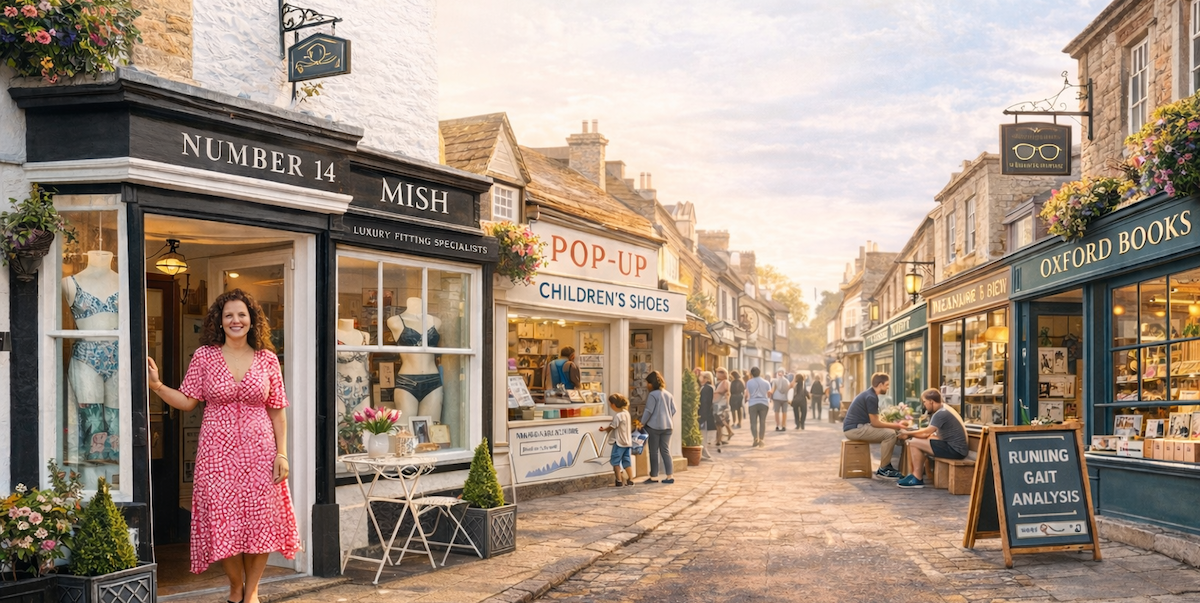
Revitalising The High Street – The Case for Rotating Pop-Up Shops
The Case for Pop-Up High Streets Why an Airbnb-Style Model Could Be the Future of Specialist Retail
For the past few years, I have been running regular pop-up shops in Woodstock in Oxfordshire with Mish. What started as a practical way to reach customers outside Cornwall has gradually turned into something much bigger in my mind.
The more time I have spent trading there, the more convinced I have become that pop-up retail is not just a useful bolt-on for independent businesses. I believe it could be a fundamental part of how we reinvigorate British high streets, particularly in smaller towns and market towns.
And crucially, not as a short-term fix for struggling retail, but as a deliberate, well-designed model that reflects how people actually shop today.
The Reality We Need to Acknowledge
There is a hard truth we do not talk about enough.
Many specialist retail businesses cannot survive in small towns if we expect them to operate like traditional shops, open five or six days a week, 52 weeks a year.
That does not mean those businesses are not needed.
It means they are not needed constantly.
A simple personal example. I buy shoes for my 18-month-old daughter roughly every three months. When I do, I absolutely want a specialist children’s shoe shop, with trained fitters and proper advice. But I do not need that shop every week. I need it occasionally, and when I do, I need it to be excellent.
MISH works in exactly the same way. Customers deeply value specialist bra fitting, but most people only need it once or twice a year, or at key moments when their bodies change. That does not reduce the importance of the service. It simply changes the frequency of demand.
This distinction matters far more than we currently allow for in how we design our high streets.
Where This Model Makes the Most Sense
This pattern does not apply to all retail. It applies very specifically to specialist businesses where expertise is critical, but the customer’s need is episodic rather than continuous.
A few clear examples illustrate this:
- Specialist lingerie fitting. Customers benefit enormously from expert fitting and product knowledge, but may only need that service once or twice a year, or around life stages such as pregnancy, menopause, weight change, or surgery.
- Children’s shoe fitting. Parents need trained fitters who understand foot development, but most only require access every two to three months. The service is essential at the point of need, not weekly.
- Running shoe fitting and gait analysis. A properly fitted pair of running shoes might be bought once or twice a year. Customers want expertise, assessment, and reassurance, but the replacement cycle is long.
- Tailoring and alterations. This is almost entirely need-based. Customers may only visit once or twice a year, but when they do, skill, trust, and experience matter enormously.
- Bridal and occasionwear. An extreme example of low frequency but high value. Customers may only need the service once, but when it appears in a town, demand can be intense and highly concentrated.
- High-end or niche fashion designers. Customers often buy seasonally, not monthly. A pop-up presence turns the brand into an event rather than something that must justify a permanent footprint.
In all of these cases, the challenge is not a lack of demand. It is that the demand is episodic rather than continuous, and forcing these businesses into a permanent high-street model often makes them financially unviable, even though customers still actively want and value them.
Why Pop-Ups Work So Well in Practice
What has fascinated me about the Woodstock pop-up is not just how busy it is, but why it works.
Over time, I have seen a constant rotation of independent brands, specialists, online-first businesses, and creatives. The unit is rarely quiet. And importantly, it is not busy because one business is trading flat out all year. It is busy because multiple businesses rotate through the space.
This concentrates demand. If you know you are trading for one week a month, once a quarter, or seasonally, you tell your customers in advance. You arrive, you trade hard, you leave. There are no dead days draining cash and morale.
For customers, this creates novelty and anticipation. The high street becomes somewhere worth revisiting, not because the previous shop failed, but because something new has arrived.
For towns, it keeps the high street feeling intentional, alive, and dynamic.
The Power of Scarcity and Occasion
This idea strongly echoes something we have largely lost in modern retail: scarcity and seasonality.
When I was a child, you only bought strawberries when they were in season. You could not buy them year-round. And because of that, when they arrived in spring, they tasted better. They felt special.
The same was true of Lindt chocolate in our house. My dad worked in Switzerland, so we might only get it once every few years. It felt like a treat. Now it is available everywhere, and that sense of occasion has disappeared.
Retail works in exactly the same way. When everything is always available everywhere, nothing feels special. A rotating high street restores anticipation, relevance, and emotional connection.
Why the Model Matters as Much as the Concept
This thinking has evolved into what I now think of as a Rotating High Street model, designed specifically for specialist and online-first retailers.
Pop-ups are not a new idea. But the way they are set up is critical.
In most towns, running a pop-up still involves too much friction. Finding an empty unit, negotiating short-term leases, arranging utilities, dealing with fit-out costs, and absorbing risk that makes no sense for a week or two of trading.
What makes Woodstock different, and why it works so well, is that the space is essentially plug-and-play.
The walls, floors, and ceilings are neutral. Lighting is already installed. A gallery rail system is in place. Heating, water, internet, and core services are included. You arrive with freestanding fixtures, set up, trade, and leave the space as you found it.
No shopfitters. No utility contracts. No hidden costs.
An Airbnb-Style Model for Pop-Up Retail
This is where I see the real opportunity.
Imagine if pop-up shops worked in the same way short-term accommodation does. You go online, see availability, see pricing, and book. No lengthy email chains, no opaque negotiations, no uncertainty.
Each town could have several of these spaces, designed specifically for rotation. Specialist retailers could move from town to town. Online-first brands could meet customers face-to-face a few times a year. Creatives could exhibit and sell without committing to permanent premises. Established businesses could clear surplus stock through focused sales.
This model reduces risk, increases accessibility, and makes physical retail viable again for businesses that simply do not fit the traditional mould.
A High Street That Evolves by Design
One of the most common complaints I hear is that high streets feel stale. The offer feels limited. The same chains appear everywhere.
A rotating pop-up model flips that narrative.
If your high street is always changing by design, it becomes a destination again. Businesses feel like events. Shoppers are curious again. And importantly, this does not replace permanent retailers. It supports them by bringing energy, movement, and complementary offer to the street.
My bottom line for 2026
I do believe it will increasingly determine which retailers can afford to deliver good retail.
In 2026, the question won’t be whether you like AI or feel ready for it.
It will be whether you can justify running a more expensive business than your competitors, doing the same work more slowly, with less margin left to invest in customers and teams.
That’s why I believe AI adoption in retail is no longer about innovation.
It’s about sustainability.
Written by Michèle Poynter, founder of Mish, the Lingerie & Swimwear specialist and The Retail Fixers. Michèle helps independent retailers grow through authentic customer experience and community-led retail strategy